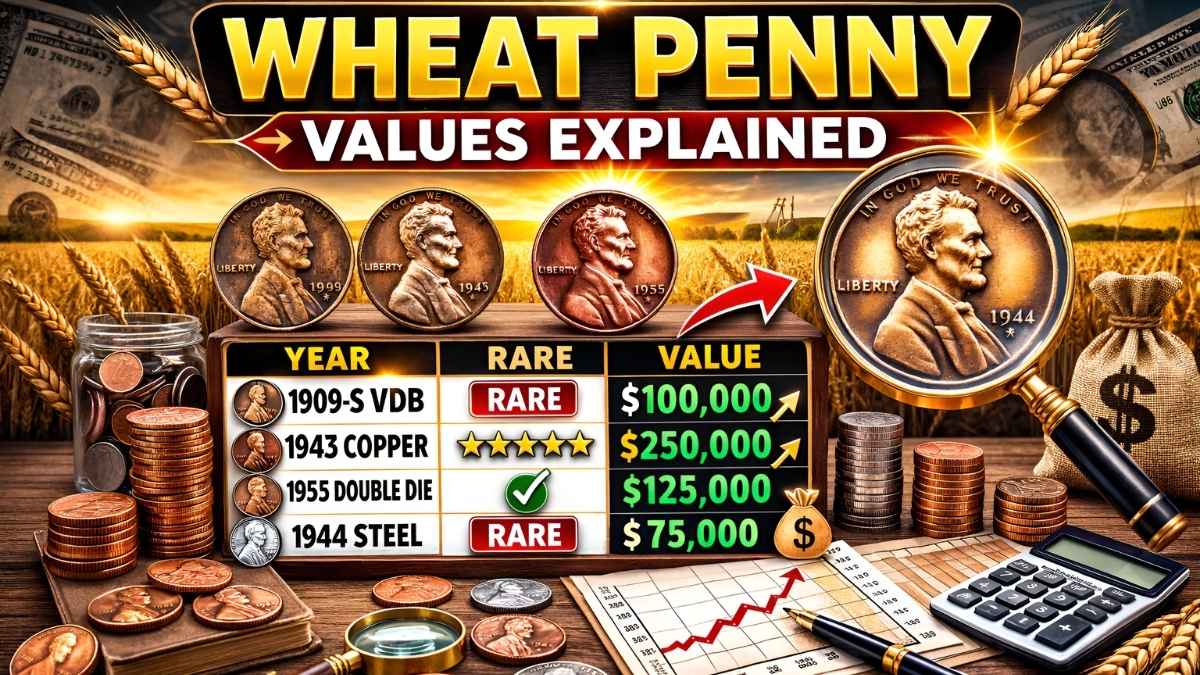
Wheat Penny Values Explained: The Lincoln Wheat penny, minted from 1909 to 1958, remains one of the most collected coins in American history. Its design, featuring Abraham Lincoln on the obverse and two wheat stalks on the reverse, symbolizes both national pride and everyday commerce. Even decades after production ended, Wheat pennies continue to capture the imagination of collectors and casual hobbyists alike. Their values have shifted significantly over time, making them a fascinating case study in numismatics.
Why Wheat Pennies Hold Value
Several factors determine the value of Wheat pennies:
- Scarcity: Coins with low mintages are harder to find.
- Condition: Mint State and Proof examples command far higher prices than circulated coins.
- Mintmarks: Issues from San Francisco and Denver often carry premiums.
- Errors and varieties: Doubled dies, off-center strikes, and wrong planchet coins are especially prized.
- Historical context: Wartime issues and first-year designs attract strong demand.
Values 10 Years Ago vs Today
Ten years ago, in 2016, most common Wheat pennies were worth only a few cents to a dollar in circulated condition. Semi-key dates such as the 1931-S or 1914-D were valued in the hundreds, while legendary rarities like the 1943 copper penny could reach hundreds of thousands.
By 2026, values have risen across the board:

- Common circulated Wheat pennies: 5 to 25 cents today, compared to 2 to 10 cents a decade ago.
- Semi-key dates: $50 to $500 today, compared to $20 to $200 ten years ago.
- Key rarities: $5,000 to $50,000 today, compared to $2,000 to $20,000 ten years ago.
- Legendary errors: $100,000 to $500,000 today, compared to $75,000 to $250,000 ten years ago.
The growth reflects increased collector demand, online auction accessibility, and nostalgia for early 20th-century coinage.
Famous Rare Wheat Pennies
Some Wheat pennies stand out as legendary treasures:
- 1909-S VDB Penny: First-year issue with designer initials, highly prized.
- 1914-D Penny: Scarce in high grades, a cornerstone of advanced collections.
- 1922 No D Penny: Denver issue struck without a visible mintmark.
- 1931-S Penny: Low mintage under one million.
- 1943 Copper Penny: Wartime error worth hundreds of thousands.
- 1944 Steel Penny: Another wartime rarity, valued in the tens of thousands.
- 1955 Doubled Die Penny: Famous for dramatic doubling on the date and lettering.
Market Trends in 2026
The rare coin market has matured, with collectors focusing on certified high-grade examples and error varieties. Auction houses report record-breaking sales, while online platforms have made rare coins more accessible. Nostalgia and historical significance ensure that demand for Wheat pennies remains strong.
Collector Tips
- Check mintmarks carefully: San Francisco and Denver issues often carry higher value.
- Inspect condition: Wear on Lincoln’s cheek and jawline is a key indicator of grade.
- Avoid cleaning: Cleaning reduces value significantly.
- Consider professional grading: Certification adds credibility and increases resale value.
The Thrill of Discovery
The idea that a penny worth thousands could still be hiding in pocket change captures the imagination. While the odds are slim, stories of rare coins turning up unexpectedly continue to inspire hope. Every coin jar, inherited collection, or handful of change holds the possibility of hidden treasure. For many collectors, the search itself is part of the excitement, blending history with the thrill of discovery.

Conclusion
Wheat pennies are more than just small pieces of copper. They are symbols of American history, artistry, and in rare cases, extraordinary value. Comparing values today with those from ten years ago shows how collector demand and market trends can transform ordinary coins into treasures. In 2026, the pursuit of Wheat pennies remains as vibrant as ever, proving that even the smallest denomination can carry immense worth.