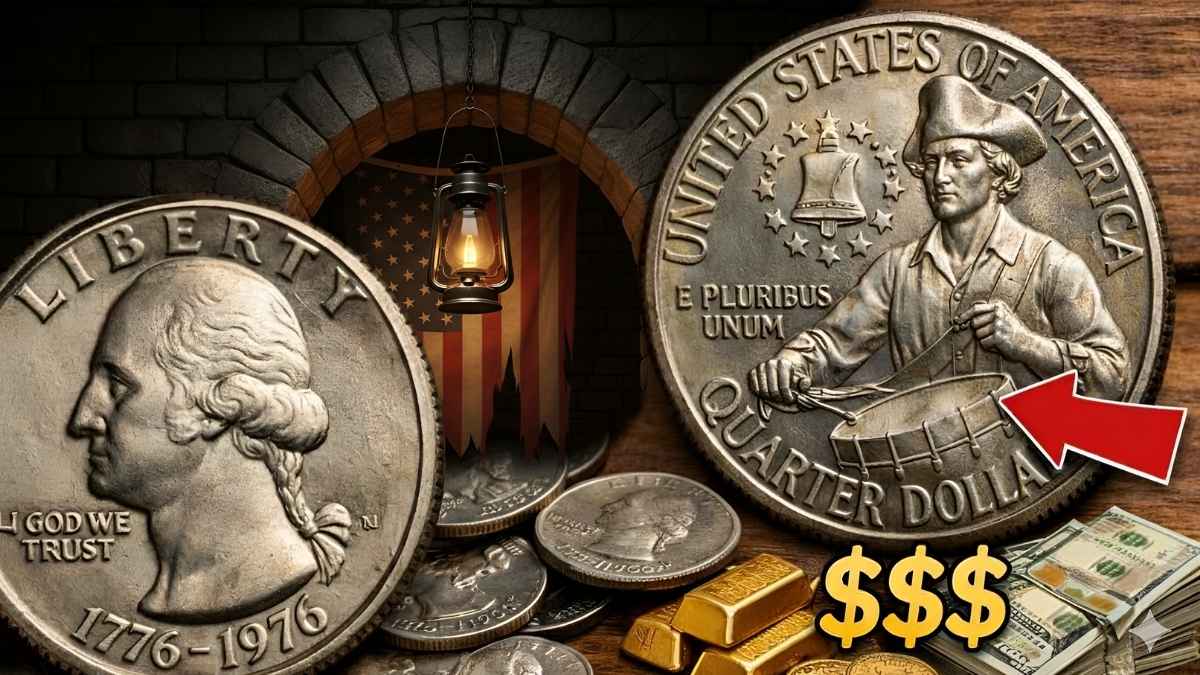
Rare Bicentennial Quarters: The Bicentennial quarter, released in 1975 and 1976 to celebrate the 200th anniversary of American independence, remains one of the most iconic coins in U.S. history. Featuring a colonial drummer on the reverse and the dual date “1776–1976,” these quarters were minted in massive numbers. Yet, within this large production run, certain rare varieties and errors have captured the attention of collectors. Some of these coins, especially silver issues and minting mistakes, can be worth far more than their face value.
The Bicentennial Quarter Design
The Bicentennial quarter was part of a special coinage program that included the quarter, half dollar, and dollar. The reverse design was created by Jack L. Ahr, depicting a colonial drummer with a torch surrounded by thirteen stars. The obverse retained George Washington’s portrait but carried the dual date to mark the nation’s bicentennial.
Standard Circulation Quarters
Most Bicentennial quarters were struck in copper-nickel clad composition, the same as regular quarters of the era. These coins were produced in enormous quantities at the Philadelphia, Denver, and San Francisco mints, making them common in circulation.
Silver Bicentennial Quarters
A special subset of Bicentennial quarters was struck in 40 percent silver. These were issued in collector sets and are distinguishable by their heavier weight and brighter luster. Silver Bicentennial quarters are more valuable than their clad counterparts, especially in pristine condition.
Error Varieties
Errors are among the most sought-after Bicentennial quarters. Some notable types include:
- Double die obverse or reverse: Coins showing doubled lettering or design elements.
- Off-center strikes: Coins where the design is misaligned, leaving blank areas.
- Clipped planchets: Coins missing a portion of the rim due to a miscut blank.
- Striking anomalies: Coins with weak strikes or unusual impressions.
Proof Issues
The San Francisco Mint produced proof Bicentennial quarters, both in clad and silver. These coins feature mirror-like finishes and sharp details. Proof silver issues are particularly prized by collectors.
Collector Value
The value of Bicentennial quarters depends on several factors:
- Condition: Uncirculated and proof coins command higher prices.
- Composition: Silver issues are more valuable than clad.
- Errors: Rare minting mistakes can dramatically increase value.
- Rarity: Limited production runs, such as silver proofs, are more collectible.
How to Identify Silver Varieties
Collectors can identify silver Bicentennial quarters by:
- Checking the edge: Silver coins lack the copper-colored stripe seen on clad quarters.
- Weighing the coin: Silver quarters are slightly heavier.
- Packaging: Many silver issues were sold in special collector sets.
Tips for Collectors
- Inspect coins carefully for errors using magnification.
- Preserve coins in protective holders to prevent wear.
- Verify authenticity before purchasing rare varieties.
- Consider professional grading for high-value coins.
Cultural Significance
The Bicentennial quarter is more than a collectible. It represents a national celebration of history and independence. For many Americans, these coins evoke nostalgia and pride, making them cherished keepsakes as well as valuable collectibles.
Conclusion
Rare Bicentennial quarters, especially silver issues and error varieties, continue to captivate collectors. While most examples remain common, certain coins stand out for their uniqueness and historical significance. For enthusiasts, building a collection of Bicentennial quarters offers both a connection to America’s past and the thrill of discovering hidden value in a coin that once circulated widely.